We are very proud to share that the team at PharosAI announced that they have been awarded £18.9M from the UK government's Research Venture Catalyst scheme. This is in addition to the £25M committed from partners across the industry, bringing the funding total to £44M.
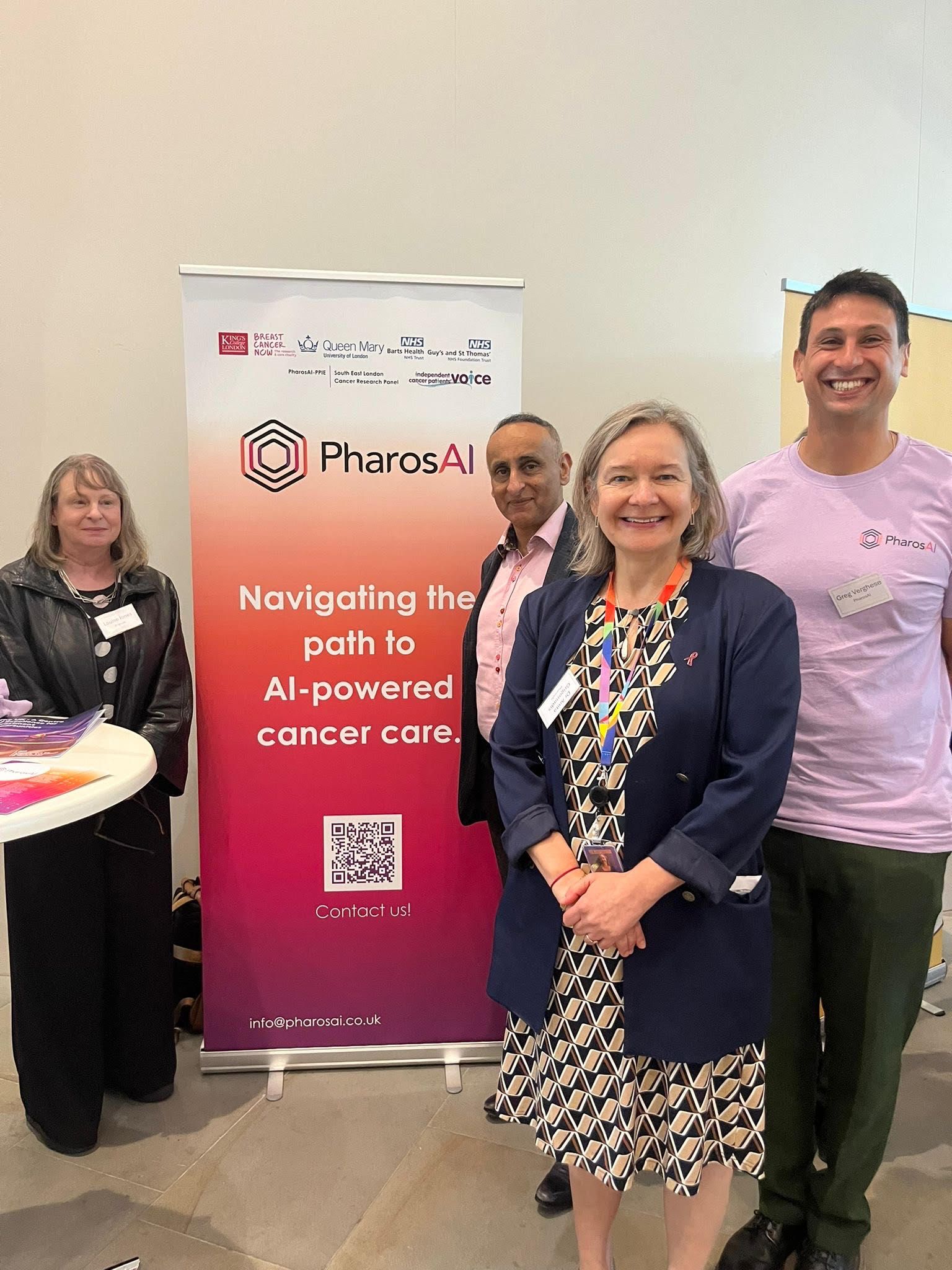
PharosAI is led by a team of researchers and clinicians from King’s College London, Queen Mary University of London, Guy’s and St Thomas’ NHS Foundation Trust, and Barts Health NHS Trust. Their mission is simple: transform cancer care by unlocking decades of NHS cancer data and hosting it on one powerful, secure, AI-ready platform.
Professor Anita Grigoriadis, CEO of PharosAI describes the initiative: “PharosAI will democratise cancer AI and create an ecosystem to navigate the path to AI-powered precision medicine. The RVC (Research Venture Catalyst) programme allows us to build a unique operational approach between two leading universities in London, two NHS Trusts and industry partners. Our innovative collaboration will accelerate scientific breakthroughs and bring vastly improved cancer care to tomorrow's patients."
They always knew what their goal was, and with the skills and experience they have, there’s few people better positioned to achieve this. But the application process is complex and there’s a lot at stake, not forgetting that the team also have full-time day jobs! So when details of the research program from the UK Department of Science, Innovation, and Technology (DSIT) emerged, they knew that a little help and guidance would not go amiss!
Dr Majid Kazmi, Chief Medical Officer of PharosAI, had some previous experience with The Grafter team, he knew that The Grafter was well connected, had strong understanding of building scalable businesses, and had experience in building health care systems that scale nationally.
Majid explains why they initially chose The Grafter: “The Grafter’s action-oriented approach was exactly what we needed to drive our ambitious project forward. Their unique understanding of the complexities of the healthcare system, advanced technology and building businesses allowed them to navigate challenges that others might have found insurmountable.”
So the PharosAI team engaged with The Grafter to help with the bid submission. But this wasn’t just a case of filling out a set of questions, in order to put forward a strong response, a complete business needed to be designed. An essential step was building an operating model for the PharosAI business to develop a next generation AI cancer research platform to grow over the next 5+ years.
One of the first engagements with The Grafter was to map out the requirements and goals, which was conducted through a series of workshops, interviews, and the strategic use of Wardley mapping to chart the components. One of the big benefits of creating Wardley maps is to help visualise how things can move as they are developed, and what the impact of that might be on other components. PharosAI isn’t creating an entire AI platform from scratch, the goal is to use trusted partners and industry leading technology solutions to power the platform. The goal isn’t to create a health-tech company, but to create positive outcomes for cancer care, so using the right technology and partners is vital.
This gave a framework for what things can look like, and built the foundation to start developing the operating model for the business. This would be essential for the DSIT bid, and it is important to show that a viable business could be funded, as well as what the path would be to leverage the available funds over the next 3-5 years. The operating model for PharosAI would pull together all the different components, partners and individuals that were required to power the platform, along with showing the flow of data exchange. PharosAI is as much about partnerships, and using the unique NHS dataset to the benefit of many working in cancer research. So understanding how these partnerships and information exchanges fit into the overall business model, while still being feasible and show a journey to a stand-alone profitable business was an important part of the bid response framework.
Through-out all of this, one of the major benefits that The Grafter provided the PharosAI team was providing programme management across all the different workstreams. There are a lot of people that need to be involved, consulted, and engaged to bring the different institutions together. This was essential when it came to pulling the response together. While input from all members of the PharosAI team was essential, the review and sign-off required a much larger pool of individuals. The Grafter helped to track, organise and follow-up with a large number of contributors and reviewers to the bid, including external partners. This was a key component of the bid; DSIT were expecting to see a unified response where collaboration was at the forefront.
Another key component of the submission was a detailed financial model. This was required to show predictions over the 5 year funding period for where and when the funds would be needed. This went through extensive reviews and modeling, the exact criteria for what would be accepted for the funding was very particular and the guidance needed to be followed closely. This also helped the PharosAI team model exactly what partners would be used, at what stages, and the staffing requirements to support the development of the project.
Putting the bid together was no mean feat, but negotiations continued with external partners, vendors and investors. To assist with this a pitch deck was required to help translate the vision of the PharosAI team. This helped secure additional funding, some of which was eligible for the Research Venture Catalyst match funding, some of which would be additional to help the initiative in future years.
The culmination of PharosAI partnering with The Grafter was instrumental in helping them secure £25M of funding from partners, and the essential support of £18.9M in funding from the UK government's Research Venture Catalyst scheme. A summary of the engagement includes:
Programme management expertise to keep progress moving forward, and everyone aligned
Financial modelling
Pitch deck creation and pitch practice
Bid construction and refinement
An estimated 167,000 people die from cancer in the UK every year, and someone is diagnosed with cancer every two minutes. Delays in diagnosis, and starting treatment later, means that cancer patients in the UK have some of the worst survival rates in the developed world. PharosAI is in a strong position to have a positive impact on cancer patient outcomes and essential cancer research, powered by the unique enriched datasets that the NHS holds, but previously have not been accessible or federated through a large AI foundation model.
Gregory Verghese, Chief Technology Officer of PharosAI, said: “PharosAI is democratising cancer AI by refining decades of oncology data into deep multimodal datasets, creating an unprecedented 360-degree profile of each patient. By uniting these enriched datasets with large AI foundation models on a secure, federated platform, we empower researchers, developers, and innovators to responsibly and ethically shape the future of precision medicine.”