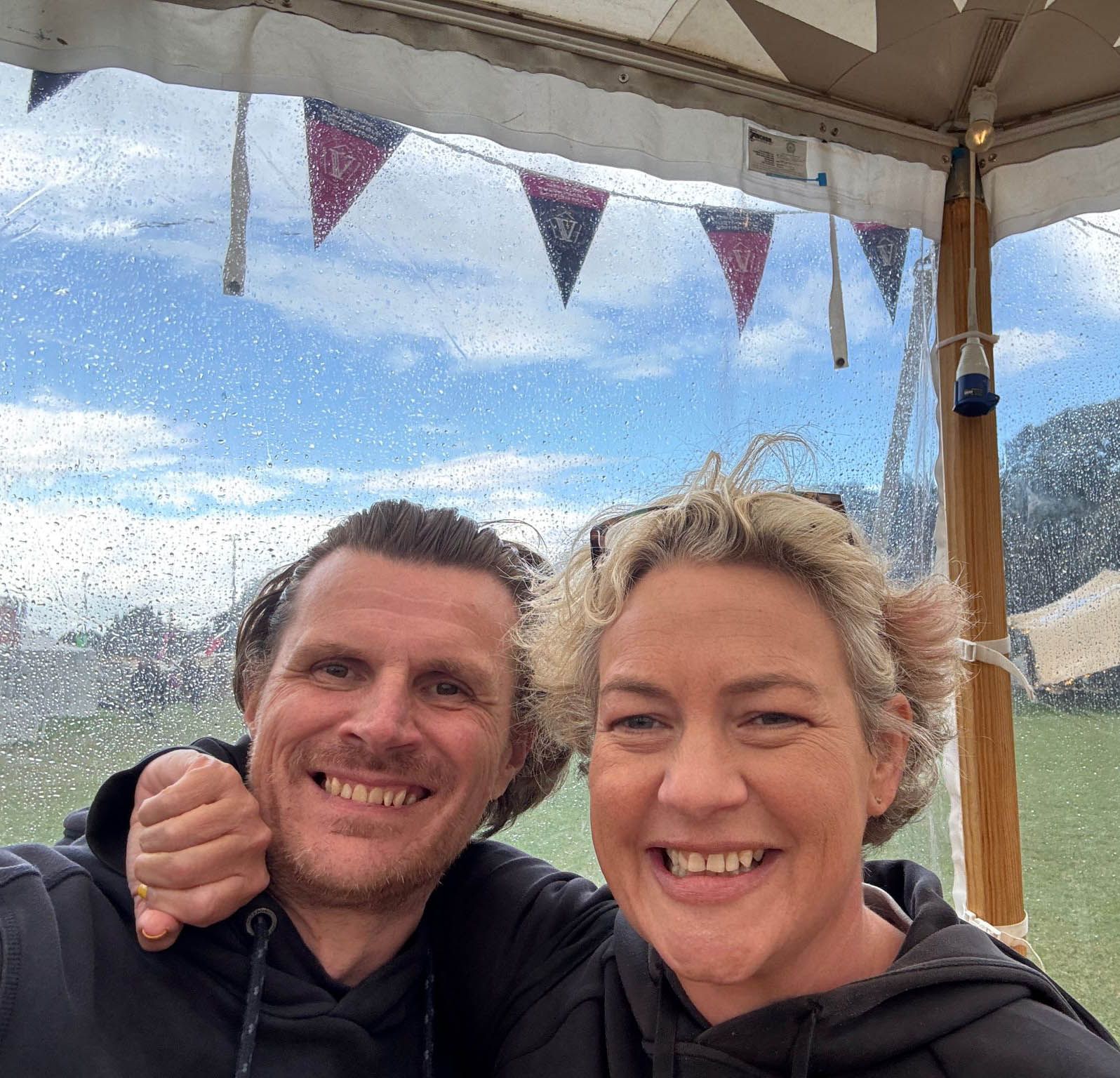
"We were sat there in March saying, 'Is this even a thing anymore?'"
Dean Mawson isn't being dramatic. Just honest. It's March 2024, and DPM has hit what he calls their biggest dip ever. They're breaking even each month. Barely. And for a business that's already been rebuilt once, already survived what Dean describes as having to "literally grow the company again" in 2022, that question isn't rhetorical.
Dean and Sonya - business partners and life partners - are genuinely asking themselves: do they pack this in? Does Dean go back to being a full-time clinical safety officer? Does Sonya return to banking? Both respectable, well paid, and stable jobs.
The Long Road to Working Together
When Dean's ulcerative colitis hit hard, Sonya was made redundant from NatWest. The timing was awful and, looking back, probably saved them. The lump sum tided them over during months of hospital visits, uncertainty, and days when Dean physically couldn't work.
"You don't get a lot of warning sometimes with a chronic condition," Dean explains. "We've learned now that you have to manage that into the business."
But learning took time. Dean would sit struggling at his desk, not giving himself rest because it felt like failure. Sonya would be there for the appointments, the difficult stretches, the backwards and forwards when he wasn't okay.
Eventually, Dean started getting better. Sonya found another job at Yorkshire Building Society and worked there for a few years. But Dean was getting snowed under with work, and the cycle was starting again: stress triggered flare-ups, flare-ups caused more stress. They made a decision: Sonya would leave the security of her banking career and come into the business full-time.
"There was quite obviously still a lot of challenges then," Sonya says carefully. "Me in a new role, not knowing what I was doing because I've done banking for so long. It was learning a different job and it did bring a lot of challenges and self-doubt."
"We bickered a bit at the beginning," Sonya admits. "Effing and blinding and then hitting a point thinking 'I'm going back to work, I don't want to work with you anymore.’"
They can laugh at the memory now, but Dean is honest about it: "I think the decision to ask Sonya to come work with us full-time - obviously I asked, I didn't just tell her - there was a huge need because when I was ill, I wasn't giving myself any rest time."
They had to work it out. Not just the business operations, but how to be partners in both senses without destroying either relationship. Slowly, they found their rhythm. Dean handles the technical delivery - he's the expert in NHS safety standards and regulatory compliance, the one people turn to at a national level for guidance. Sonya manages the organisation, the client relationships, brings her decades of customer service experience from banking.
"Good cop, bad cop," Dean says. "Sonya's good cop, always. If I need to get involved in certain conversations, then I need to get involved, and that's fine. That works really well."
But Sonya's more specific about what made the difference: "I know to look and say: Right, we've got all of this coming, we might need to push things back or we might need to cancel. We work in partnership like that. I have my role, Dean has his role, and we've got that to a T now we’ve found that balance."
Building Without Blueprints
By the time they hit that low point in spring of last year, some things were actually going well. Dean had created a CPD-accredited Clinical Risk Management training course. They'd launched a podcast to raise awareness of compliance in the NHS, and that had made a huge difference: awareness went up, business started picking up.
"Since then it's just gone in that direction, which has been absolutely fantastic," Dean says.
But something fundamental was missing, and Dean knew it. They were riding the peaks and troughs of NHS consultancy life without any real structure underneath. They needed to sort out their marketing, which Dean is brutally honest about.
"Marketing is one of those areas that most small organisations often do quite badly or they struggle with. And we did. I just held my hands up and said: We do it badly and we need support."
More than that, though: "We don't have a business strategy, we don't have a roadmap, we don't have any of this stuff. We need help."
Dean had bumped into Rachel at conferences over the years, always stayed connected. When she started The Grafter, he was curious. They eventually had a proper conversation, and he was honest with her: "We're getting to the stage where I've got first world problems - oh my God, there's too much work. People say, yeah, nice position to be in. But you start to see the cracks. Not in delivery of projects, but managing the organisation. The organisation is starting to squeeze you."
For a small, bootstrapped business, bringing in outside help isn't a casual decision. You've got to manage that carefully. But Dean could see they needed it. The question was whether it would actually help or just be more corporate bollocks they didn't need.
The Guardrails They Didn't Know They Needed
"I didn't know what to expect," Dean admits about starting work with The Grafter team. "But it was really nice to see a team that were just so down to earth, really informal. It makes you relaxed. When you've got all this stuff going on, it brings it down to a level. Nice and calm."
They started going through the programme. Sessions with Rachel, John, Chris. Questions about ideal customer profiles, business strategy, market access, NHS frameworks, all the foundational stuff they'd never been able to sit down and do properly.
And then something clicked.
"When you start asking the questions of your own organisation and you see it in black and white," Dean pauses, "that's when it's almost that epiphany. It's not like going: oh my God, there's so much to do in a negative way. It's like: blimey, we've got direction. There's something to focus on now and it's in a structured fashion."
What they got, essentially, were guardrails. Not rules or restrictions, but frameworks that kept them on track while still letting them drive the business their way.
"We know our business," Dean explains. "I'm a thought leader in that space. People look to me for advice at a national level. But we needed guardrails and frameworks around how to have these conversations, how to approach this stuff. We had 99% of what we needed, it just wasn't structured in the way we needed to execute with it."
For Sonya, those guardrails changed everything.
She'd been struggling with something she couldn't quite articulate. Dean was always busy. She felt like a burden constantly asking questions. She was trying to learn as she went, getting scared thinking she might be doing things wrong, but with no clear way to check or no structure to follow.
"I just didn't know, and didn't have any direction," she explains. "Dean's always busy, so I feel like I'm being more of a burden, constantly asking."
The systems gave her something concrete. Tools she could actually use. Ways to organise her thinking and her work without having to wait for Dean to advise her every step.
"Then talking to the team, the penny sort of dropped," Sonya says. "You just think: Why am I panicking? At the end of the day, you've got tools to help, just use them. Then I'll go to Dean and say: What do you think of this? At least the bulk of it's done, rather than having to wait for him to walk me through doing it from scratch."
But the guardrails did something else too, something neither of them quite expected. They made it easier to work together as partners.
"It helps us make the decisions together as well," Sonya explains. "Sometimes Dean will think of something and I'm always the cautious one. I'm always the one that says: Should we be doing that? And Dean's like: Well, why are you being so... But I just naturally err on the side of caution. We've been bitten twice with a lot of things. I don't want us to be back in the same boat again. So I'm more cautious for him more than anything else. We sit and discuss things, then we meet in the middle."
The structure didn't just help them run the business better. It helped them be better business partners.
Watching Someone Come Into Their Own
Dean stops mid-interview to point something out. He's noticed something about how Sonya's been talking, and he wants to say it while it's fresh.
"It's really great, actually, listening to Sonya talking now in this session," he says. "If Sonya listened to herself back from a year ago, she would not have been talking like this. She wouldn't have had the confidence to do it."
He's right. The woman who stressed about if she'd made a mistake leaving banking, who felt like she had her head stuck in the sand, who was terrified of being a burden - that person wouldn't have been talking about team investment strategies and sustainable growth.
"I'd like to think some of that's come from me, that's rubbed off," Dean continues, "because it's all about making sure everybody else is all right within the business. But Sonya's absolutely right."
Sonya's transformation isn't just about confidence, though that's part of it. It's about ownership. She's not just helping Dean anymore. She's running her part of the business, making decisions, seeing the bigger picture. The guardrails gave her the structure to step into that role properly.
"It has been a breath of fresh air," she says simply. "I think the penny sort of dropped and you just think: Why am I panicking? You've got tools & systems to help now. You just use them and do what you can. It makes us make the decisions together as well."
That last bit matters. Not just that she can make decisions, but that the framework helps them make decisions together. The guardrails don't just keep them on track individually, they create space for them to navigate as a partnership without the friction and frustration that used to derail them.
Growing Something Sustainable
They're bringing on subcontractors now. The training side has gone absolutely crazy: "I can do it standing on my head," Dean says, not boasting, just honest about where his strengths lie after years in the field.
“I think we’re bringing on clients at the right pace, it feels like steady growth”, Sonya observes of where they are as a business today.
But Dean's very conscious of what comes next.
"The only thing I will say, because we don't agree on everything," Dean interjects, "I think we're totally not. We need more leads and we need to be in a position where it's like: Oh my God, we've got all these leads, what do we do with them?"
Sonya laughs. "We've got more than we had. I'm busier than I used to be because I'm much more involved."
It's not really a disagreement, though. It's them navigating their different perspectives - Sonya cautious from past experience, Dean ambitious and forward-looking. The difference now is they have the support and guidance for having these conversations without it turning into effing and blinding, it's much more constructive swearing now.
"I'm conscious of sustainability," Dean explains. "We're taking these people on, we have two fixed term employees, we're looking at other similar opportunities, but it needs to be sustainable. We need longevity. We're not just bringing these people on, doing it for a short period and going: Oh sorry everybody, there's a downturn now because we've been lazy or not built sustainability into the business. I don't want to do that."
The next six to twelve months? More team growth. The client base is continuing to grow. Working towards ISO certifications themselves, in part to showcase their own expertise. Dean maintaining his thought leadership position in the NHS digital health space. Sonya continuing to grow into her confidence as a business partner who knows her role and owns it.
"I think we'll be in a better position than what we are now," Sonya says. "The client base is growing slowly, but at the right speed, and it is a matter of us being more structured with our time. We'll have more people on board with us, which will make the business grow a bit more. It's just investing in time, in the people that we will have with us, because we want them to enjoy working with us, along with us actually, on the journey."
Dean's clearly proud hearing her talk like this. "It's really exciting times now," he says. And you can hear that he means it.
The Advice They'd Give
If Dean could go back and meet himself two or three years ago, the message is clear.
"Get support together as soon as you can. Don't worry about not having the resources. If you know your business, you're more than capable. But get the right support for doing that. Whatever that looks like, go and speak to the right people, make sure you've got the right support. Because if I'd done this two or three years ago, we would have been in a much better position now. I'm not saying we're in a bad position, but we held back for a couple of years. It just means we hadn't been able to move forward. Whereas now, the world is your oyster. Let's crack on. It's all positive."
The guardrails, the frameworks, the structure - it wasn't about being told what to do. It was about finally having a clear way to execute what they already knew needed doing. About having the space to work together as partners without the friction. About giving Sonya the confidence to step into her role fully.
They've learned to build something sustainable not despite the challenges - the illness, the restart, the NHS budgets, the friction of learning to work together, the caution born from past losses - but by acknowledging them, managing them, and finally getting the guardrails to navigate them together.
They're no longer asking "is this even a thing anymore?"
They're asking "what's next?"
And now they have the structure to actually answer that question together.