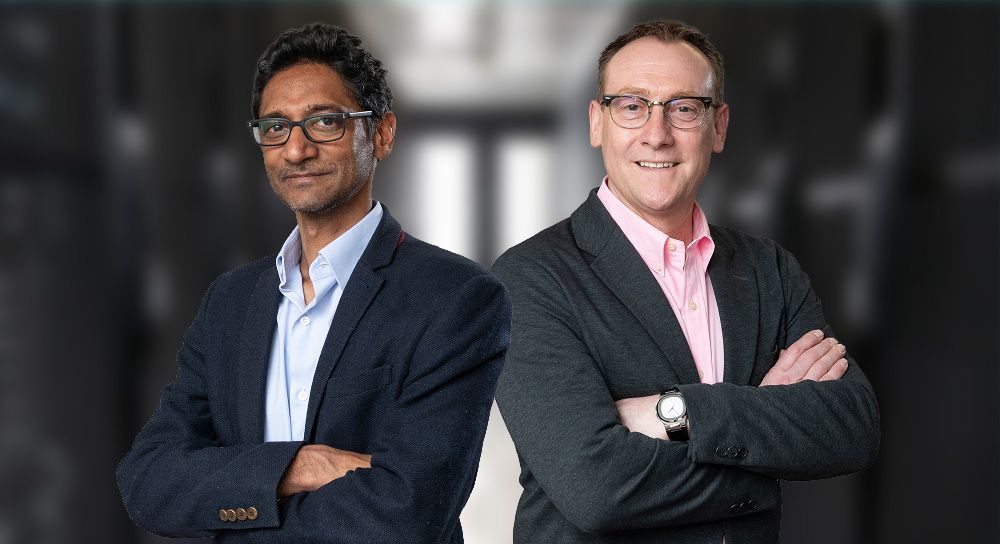
"I wake up, and I'm 55," Vijay says with a wry smile during our video call. When I tell him he doesn't look it, he shoots back: "I feel it." His business partner Paul, 56, laughs from across their meeting room. "I'd have put on some makeup if I knew we were recording this," Paul quips.
These aren't your typical startup founders. Paul and Vijay run VIPA Digital, a Data Centre Management consultancy that helps Investors, Data Centre Operators and End Users with technical, market and commercial due diligence. They handle the complex logistics of designing and constructing these facilities, the infrastructure, backup power systems, cooling, all the critical facilities that keep the digital world running. At an age when most corporates are coasting towards retirement, they're building a successful business and orchestrating their own exit strategy.
"We're corporate animals by background," Vijay explains. "Both of us having worked in banking and infrastructure environments for a very long time. We started the company when I was 48, Paul was 49. It was sort of the last hurrah, if you like. An attempt to do something interesting, useful and exciting between the ages of 50 and 60."
The Chance Catalyst
The path to addressing their own succession planning came through a chance off-hand comment. "It was actually my brother-in-law," Vijay recalls. "He mentioned there was a company presenting about exit values and preparing for exit. So Paul and I went down."
That presentation by The Grafter turned into what they describe as an "accidental meeting that went very well." The small world of British business revealed itself when an old uni mate Vijay hadn't seen in 35 years, Simon, tapped him on the shoulder at the same event. "Obviously he's an entrepreneur himself," Vijay notes. These connections matter in ways that virtual meetings never quite replicate.
"In for a penny, in for 30 grand," Paul says of their decision to engage The Grafter. "We genuinely thought that if we would probably come out the other end knowing a little bit more, that would be great. If we came out the other end having achieved something, that would be easily worth the 30 grand on the valuation of the business."
The Comfortable Trap of Success
Here's where their story diverges from The Grafter's typical clients. When The Grafter ran their business diagnostic, something unusual emerged: nothing was on fire. It’s usually for founders and entrepreneurs to come to The Grafter when they need help or something is on fire. But they'd built something solid, profitable, and growing steadily.
Yet despite working on complex projects in the data centre sector, they were stuck in what Paul calls "meandering through success." They knew the rough mechanics of what an exit entails: multiples, valuations, earn-out periods, but not the details or the speed bumps.
"If it wasn't for The Grafter, we would have done nothing about it," Paul admits with remarkable candour. "We would have carried on running our business and that would have been great, and it would have continued to have been successful, but we would have done no preparation whatsoever for what we know we had to do, because it's what we do for a living, for other people."
Discovering They Were Further Along Than They Thought
Working with James Gairdner, their Exiteer from The Grafter, on a weekly basis, "teasing out what we stood for, what the vision was," something unexpected emerged. Through systematic evaluation of their financials, market position, and growth trajectory, a picture formed that surprised even these seasoned professionals.
"The 'oh shit' moment," Paul calls it, "was realising we're in the zone a year or 18 months sooner than we thought we would be."
The valuation exercise particularly stood out. When James presented the potential valuation range based on their sector's heat and their company's performance, it "startled us a little bit," Vijay admits. "Traditional multiples don't really apply. Our sector is sort of outside that typical range." We all know the old adage of the best business to be in during a gold rush is selling shovels, and with the current AI boom, building efficient, power-hungry data centres has never been so hot!
But understanding value brought complexity. The maths revealed something that made them double-check that selling the business was the right idea fundamentally. In certain scenarios, they could earn more during an earn-out period than they'd receive from the initial sale. This led them to explore Employee Ownership Trusts, management buyouts, and other mechanisms where they could extract value and hand the business onto the next layer of management to do the next cycle.
Not Your Typical Tech Startup
Paul and Vijay didn’t think they were The Grafter's typical demographic. "We're not producing a product, we're not developing software, we're not healthcare," Paul points out. They're an engineering consultancy, no software as a service, no scalable product. But the more the work and advisory continued, the more they realised just how much experience The Grafter had that could help.
So they took what The Grafter created, their Information Memorandum and flipped it into a visual PowerPoint deck more suited to their industry audience. "We've shared that with James," Vijay says, "and hopefully there may be some suggestions in the way you present to different audiences."
It's this collaborative spirit that defines them. They're not just taking advice; they're improving on it, sharing back, helping The Grafter expand their approach. They're even started mentoring younger entrepreneurs now, giving back is part of who they are.
“We’ve started working with two really young entrepreneurs in their twenties. We're very impressed by them, but there are a lot of hurdles to overcome, and help them to navigate, and to learn from our learnings. I think the challenge that really smart individuals have is that they don't have the experience and the credibility. I don't mean that in a negative way, but that just comes through time and experience of actually doing stuff.“
The Partnership That Makes It Work
Throughout our conversation, Paul and Vijay build on each other's thoughts seamlessly. "Sometimes we finish each other's sentences," Paul notes. "Our perspective is really well aligned. It's not like Vijay's 20 and I'm 60, although it might look like that somedays."
"I don't think I could have done this without Paul," Vijay says simply. "And we've both been on the journey. So I’d say to those founders who are starting the business themselves, find other colleagues who are doing this."
Their alignment extends beyond business strategy to life timing, both clear that they don't want to "crash headlong into our 60s" without a plan. "One of the beauties of this relationship," Paul explains, "is we're very aligned on age, background and outlook."
The Un-British Approach to Selling
As they prepare for the next phase, Paul and Vijay are taking an unusually open approach. "I've never quite understood why some organisations when they come to this point are sort of coy and cagey about what they're doing," Paul says. "If I'm trying to sell something, I need everybody to know that I'm trying to sell something. Otherwise I may be missing someone who would have been interested."
They're currently in discussions with an organisation offering a high degree of cultural fit, which is hugely important to them both. "Within the next 12 months," Paul predicts, "I think there will be as little as three months, I think up to Christmas and certainly within 12 months, there'll be clarity about where we're heading."
What Comes Next
The buyer pool reflects their unique position in a critical infrastructure sector. It could include other engineering firms wanting scale, investment vehicles looking to capitalise on the data centre boom, or tech companies seeking to bring their facilities expertise in-house.
The remarkable thing? Their worst-case scenario is continuing to run a successful, growing business. "This isn't a fire sale," Paul emphasises. "We're not desperate to sell, but it was part of the plan and to be true to ourselves, we need to carry out the plan."
The Advice They'd Give Others
When asked what they'd tell another founder in their position six months ago, both men return to the same theme: get help, and give yourself permission to need it.
"Get help," Vijay says. "You're not there alone. There's learnings from everyone at different points in their journey." He's genuinely impressed by The Grafter team, particularly Rachel, who he calls (borrowing from WhatsApp chatter) "a freak of nature" for the amount of ground she covers and energy she brings.
Paul cuts to the chase: "Work out what you want. If you don't know what you want, then it's difficult to articulate it, difficult for anyone to help you."
As our conversation winds down, Paul reflects on what might have been: "We'd still be working on the damn Information Memorandum if it wasn't for The Grafter." Vijay laughs in agreement. They had all the knowledge, all the expertise. They just needed someone to, as Vijay puts it, "cut to the chase and get us motivated to do something about it."
That timing, it turns out, might be rather more perfect than they'd originally thought. After all, when you're in your mid-fifties, and the lights on the cars remind you that autumn's coming, there's something satisfying about discovering you're actually 18 months ahead of schedule.